
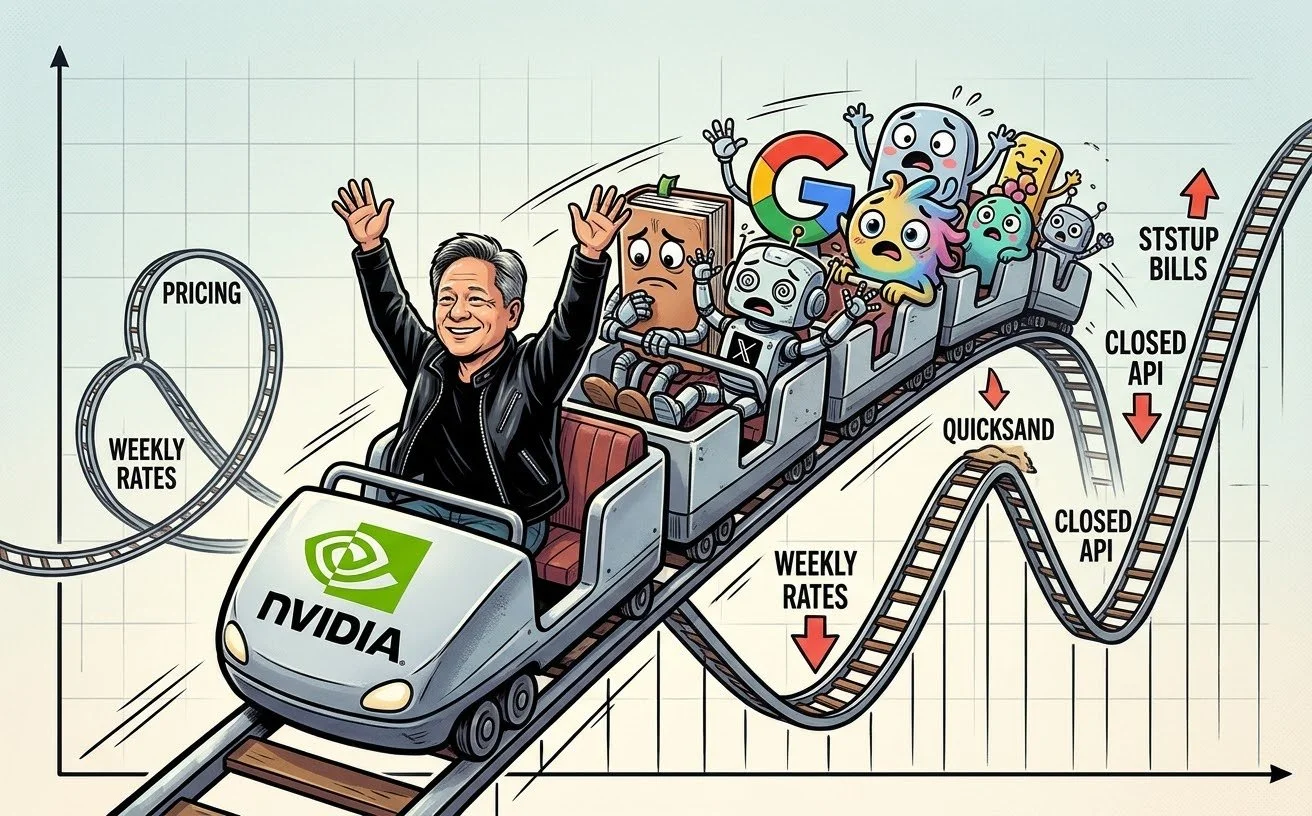
With pricing tiers and features changing by the week, renting intelligence isn't a long-term strategy. Owning it is.
Consequences are for the renters, not the executives. At the very top of the AI pyramid, one leader's personal life can rattle trillions in market value, spill over into national politics, and set off endless morality debates about workplace relationships while freezing business roadmaps worldwide. Stop and think about how wild that really is. One person's private choices behind closed doors can swing retirement accounts, stall supply chains, and shake the entire global economy. Yet you can watch a sudden ouster dominate the headlines one day, see a swift reinstatement right after, and watch the people in the corner office walk right back to their equity without missing a beat.
Nobody in the C-suite pays the price for that whiplash. If a regular employee crosses an HR line, they lose their badge before lunch. At the top of the tech stack, the rules bend because too much money is riding on one chair. The builders, small businesses, and everyday employees and operators further down the ladder are the ones left absorbing the shock.
Playing Both Sides of the Fence
Look closely at what was actually in jeopardy during that leadership chaos. Nvidia is not just a hardware and chip company anymore. That famous "moat" everyone on Wall Street loves to talk about is really the underlying software plumbing: CUDA, networking, and developer lock-in, designed to force the entire industry into buying tremendously overpriced SoC and RAM chips. Under Jensen Huang, Nvidia has been going hard into open weights and open source, pouring resources into Hugging Face, expanding its NeMo framework, and releasing capable open-weight models like Nemotron. Not out of charity, of course, but pure leverage. When open models are strong enough and free to grab off Hugging Face, businesses don't need to pay steep API markups to closed labs. Instead, they get funneled straight into Nvidia's software plumbing, where they have to pay absurdly inflated margins for silicon and memory just to run the models.
Now put that right next to Anthropic's public offering. Anthropic's entire Wall Street pitch is built on a rival tollbooth: closed weights, premium subscriptions, and metered API tolls.
Everyone at the top loves playing both sides of the fence in public, smiling on stage together while quietly trying to undercut each other's business models. Behind closed doors, closed-model labs view good open-weight models as a direct threat to their billion-dollar valuations. If Nvidia's leadership had permanently changed course, all of that momentum behind NeMo, Hugging Face, and open weights could have stalled overnight. For the closed-model crowd, Jensen stepping away was a massive breath of fresh air. Maybe the timing right ahead of Anthropic's IPO window was pure coincidence, or maybe the timing just worked out a little too neatly for the companies selling closed tokens. You can connect your own dots.
To make it even messier, the biggest AI labs are scrambling to move their workloads onto AMD GPUs, Google TPUs, Amazon Trainium chips, and custom in-house silicon just to escape Nvidia's overpriced memory and CUDA software lock-in altogether. Think about that dynamic: your main chip supplier is funding free open-weight models to undercut your paid API and move marked-up hardware, while you are rushing to rival silicon just to fire your chip supplier and one boardroom scandal almost flipped the whole table. Everything in this industry is shifting so fast right now that it is genuinely hard to wrap your head around it.
Let's be honest. If the entire global economy and political conversation hold their breath over one leather jacket, overpriced hardware moats, and one executive's personal life, we aren't looking at a stable foundation. We are looking at a top-heavy power structure where drama at the top is theater, and the volatility rolls downhill to everyone else.
The $3 Million Wake-Up Call
Down on the ground, away from the billionaire soap operas, the invoice always shows up on time. Right now, that bill is exploding.
Forbes recently put hard numbers to a problem hitting businesses everywhere: AI sticker shock. Back in late 2024, Heidi cofounder Yu Liu realized his medical note-taking startup for doctors was burning up to $3 million every single month just to use the latest models from OpenAI, Anthropic, and Google. His company was bringing in strong revenue, yet once he subtracted the AI bills, his margins were practically gone.
Liu made the exact bet Silicon Valley told every founder to make. Plug straight into black-box cloud APIs, dump your workflows onto someone else's servers, and wait for the big labs to lower their prices once intelligence became cheaper to serve.
It didn't happen. Instead, the bills kept piling up.
Pricing Built on Quicksand
Venture-backed startups aren't the only ones getting squeezed. Independent builders and solopreneurs are running into the exact same trap.
Look at what happened with Grok Bot. At first, it felt like a real breakthrough for independent operators and genuinely changed what one person could build alone as a solopreneur. Then reality hit the balance sheet. Elon Musk admitted Grok Bot was losing money. Almost overnight, users were met with shifting weekly rate limits and constant changes to what their subscriptions actually covered.
Try to untangle your workflows and leave, and it gets even messier. Between xAI, SpaceX, Tesla, and whatever new corporate wrapper or consolidation comes next week, builders are left trying to run steady operations on shifting ground.
Closed-model pricing is built on quicksand. If your business depends entirely on cloud APIs subject to surprise rate changes, TPU migrations, corporate reshuffling, and executive drama, you don't own your tech stack. You are a tenant, and the landlords will rewrite the lease the second their math stops working.
Why "Good Enough" Wins the Real World
Here is what businesses are finally waking up to when they look at how their employees actually work day to day: open-weight and open-source models are essentially free outside of your hardware and the electricity it takes to run them. And you don't even have to buy into enterprise-priced data center monopolies to run sensible models locally. When cost and data privacy are your two biggest concerns, local open weights change the math completely.
In tech, everyone is conditioned to chase the bleeding edge. Every week brings a shiny new benchmark, and companies get tricked into paying top dollar for maximum reasoning on every single prompt. Stop and ask a practical question: unless you are running a full house of software developers pushing frontier code all day, do your employees really need the most expensive cloud model on earth? Or do you just need a reliable local model that knows enough to draft an email, summarize a report, search internal files, and answer the question right in front of them?
For 90 percent of business operations, current open-weight models are more than good enough. And for the rare moments when an employee hits a wall and genuinely needs heavy cloud reasoning, a smart local setup can strip out your private company context and send an anonymized request out to a big cloud model without exposing who you are or handing over the keys to your business. It is a lot like the private handoff architecture Apple has been trying to build, even if Apple itself is still way behind on actually delivering it. You don't have to wait around for Cupertino to catch up. Businesses can build that kind of private, hybrid routing for themselves right now using open weights.
Owners vs. Renters
This is the real divide forming in the agentic era. It isn't humans versus machines. It is owners versus renters.
Well-funded giants can swallow multimillion-dollar monthly token bills and cut private compute deals behind closed doors. Smaller businesses, clinics, agencies, and independent builders get pushed onto rate-limited tiers, taxed on every token, or priced out of their own profit margins. At the same time, local communities are left paying higher utility bills as massive data centers burn gigawatts of natural gas down the road. The upside gets locked behind proprietary walls while the costs are shared by the public.
Meanwhile, China is dominating the low-cost, open-weight AI market right now while major American labs keep their best models locked behind paywalls. The gap has gotten so wide that Fireworks cofounder Lin Qiao publicly called on OpenAI and Anthropic to release open models so American businesses can keep up.
Think about that contradiction for a second. Washington tells everyone to hurry up and stay ahead of foreign competitors, while Silicon Valley's biggest labs hoard the weights and tax domestic startups out of their margins. Really? So we are supposed to win a global race by charging our own builders a toll on every single prompt?
Getting Off the Quicksand
Let's take a breath and stop sprinting into someone else's tollbooth.
Open weights aren't just for hobbyists anymore. They turn AI from an unpredictable monthly bill into infrastructure you actually control and can budget for.
You don't need a massive server farm or overpriced enterprise racks to take back ownership of your business. Practical teams and solopreneurs are already changing how they build:
Match the model to what employees actually need. Unless you have a room full of hardcore developers, stop paying frontier cloud prices for everyday office work where a local open-weight model is already good enough.
Treat AI like hardware and electricity, not a tax. Pull efficient open-weight models from Hugging Face and run them on right-sized local machines or fixed-rate private instances so you skip both the token meter and the bloated hardware markups, letting you actually budget your costs.
Use anonymous cloud routing for the edge cases. Keep private data on your local open-weight model first, and only pass stripped, anonymous queries out to big cloud models when a task truly requires extra firepower.
Keep your exit doors unlocked. Build your systems so you can swap models and underlying plumbing cleanly. Never wire your core operations so tightly into one company's API or proprietary chip stack that a Tuesday pricing update wrecks your quarter.
At the top of the tech world, leaders can crash into the guardrail on Monday, dominate global politics and workplace morality debates on Tuesday, get handed the keys back by Friday, and never feel a scratch. Consequences are for the renters, not the executives.
You don't have to keep renting. Stop treating black-box cloud APIs like public utilities. Move toward open weights, smart anonymous routing, and private owned intelligence, where your data, your margins, and your business stay in your hands.
Navigating this AI circus on your own doesn't have to be another full-time job. Halflife Studios cuts through the hype and industry whiplash to help you build practical, private AI systems you actually control and can budget for. From deploying right-sized open-weight models locally to setting up smart, anonymous cloud routing, we give you a clear roadmap off the token treadmill.
