
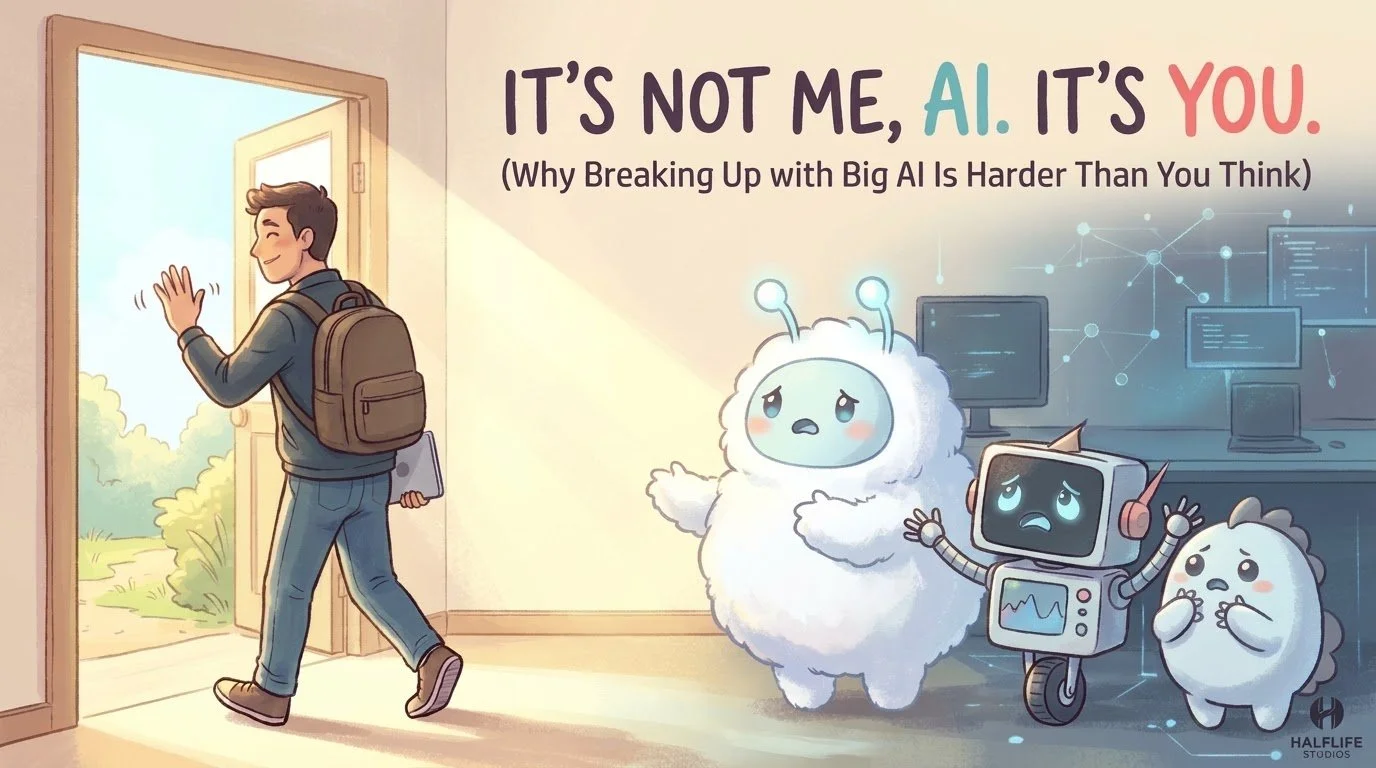
Why Breaking Up with Big AI Is Harder Than You Think
Everyone loves talking about how fast they onboarded AI. Almost nobody talks about the messy, slightly paranoid reality of trying to get your life and business back out once the honeymoon ends.
Over the last few months, I started deliberately pulling centralized AI out of my day-to-day workflow. Not because I suddenly turned into a Luddite who wants to churn butter by candlelight. I build with AI for a living. I pulled back because I watched the major labs quietly morph from helpful software utilities into clingy, corporate wiretaps.
You know the type of bad relationship I'm talking about. They change the pricing overnight. They rewrite the terms of service while you sleep. Then they roll out "proactive" desktop agents like Muse that cross the line from helpful assistant to stage-five clinger: rifling through your local folders, reading your open apps over your shoulder, and "anticipating your needs" before you even ask. That isn't convenience. That is surveillance with a clean UI.
Let's be real. Once you notice how far the creep has gone, your gut says it's time for the breakup talk. Stop feeding cloud models your raw thinking. Change the locks. Move your real work back inside your own walls.
That's when the plot twist hits: breaking up with Big AI is way harder than letting it move in.
You pay the rent, they sell your diary
For the last two years, smart operators treated chatbot input boxes like a private confessional. Founders, executives, and clinics dumped unredacted spreadsheets, financial models, client notes, and half-baked 2:00 AM panics straight into a browser tab. Vendors loved every second of it. Better yet, they trained us to keep long, running chat threads where every mundane follow-up re-ships the entire conversation history and spins the token meter all over again.
Now the second shoe has dropped: in-chat advertising.
Stop and think about who is sitting on the most surgical ad-targeting machine in human history. It isn't legacy search or social media anymore. It's the company holding your full chat transcripts, your unreleased product specs, your cash-flow headaches, and your late-night blind spots. You pay a monthly subscription for the privilege of training their next frontier model on your intellectual property, and now your private context is primed for ad targeting, data brokers, and the highest bidder. Once those weights absorb your secret sauce, there is no "undo" button. Congratulations, you paid cloud rent to help train your competitor's next feature.
Deleting the app doesn't change the locks
Most people think dumping a tech ecosystem is as simple as dragging the icon into the trash.
Not even close.
Remember six months ago when you gave an AI wrapper access to your Google Drive, your Slack, or your GitHub just to knock out one fast Friday project? You deleted the desktop app and forgot all about it. Meanwhile, that OAuth token is still sitting wide open in the cloud like a spare key taped under the doormat. The hooks into your files stay hot long after you think you walked away.
Big AI builds offboarding to be lopsided on purpose. Moving in takes one cheerful click. Getting them out of your house takes a scavenger hunt through buried privacy dashboards, third-party auth consoles, and blind faith that their retention pipelines actually purge your backups when you ask nicely.
The wild west outside the walled garden
While Big Tech gets nosier inside the garden, the open internet outside has spawned a whole different headache: unwalled, abliterated models running loose with zero brakes.
Regulators are busy passing out voluntary safety handshakes and asking polite panel questions about whether we can "trust AI." Good luck with that. On November 13, 2026, the FBI dropped an urgent cybersecurity advisory warning businesses that cybercriminals and state-backed crews are using ARTEX to breach enterprise networks in under three hours. The exact AI tooling built for automated penetration testing and red-teaming got reverse-engineered, weaponized, and pointed at real companies.
Stack that up against regular cloud outages and aging business infrastructure held together with duct tape and SaaS logins. Handing a hosted cloud bot blanket access to your files, email, and network in this climate isn't innovation. It's leaving the vault open with the lights on.
How to break up without going back to the Stone Age
Here is the good news underneath the bleakness: panic is optional, and you don't have to swear off AI to protect yourself. We aren't anti-AI. We're against leasing your brain from a landlord who reads your mail.
The pro move is a clean boundary. Treat big cloud models like a sharp, high-priced outside consultant you don't fully trust. Bring them in for surgical, sanitized bursts, never for raw company secrets, and never through an ambient desktop listener vacuuming up your screen.
If you're ready to have the "it's not me, it's you" talk this week, start with four moves:
Change the locks today. Open your Google, Microsoft, Slack, and GitHub security settings right now. Revoke every AI connector and OAuth token you haven't actively used in the past seven days.
Put cloud chat on a strict diet. Strip client names, customers or member details, raw ledgers, and internal roadmaps before anything touches a public prompt. Start fresh, stateless chats instead of feeding one endless thread.
Bring your real thinking into the yard. Run your sensitive analysis and daily grind on local silicon you physically control, whether that's a Mac or deskside box under your desk or a private server behind a hard firewall.
Just say no to clingy agents. If a tool demands full screen recording and local file permissions just to "anticipate your workflow," shut the door.
Fly with your eyes open, don't sink into the hype. You either own your keys, your hardware, and your context, or somebody else owns your business.
At Halflife Studios, our Forward Deployment Engineering and fractional CXO work exists for exactly this moment: slowing the cloud stampede just enough to map where your data actually goes, cut wasted token spend, and stand up private, local-first AI on gear you control, with a human firmly in the loop.
Breaking up with Big AI is harder than you think, but staying locked into expensive, public cloud models costs you control over your own data. Ready for an exit strategy?
Download your AI breakup checklist and white paper here (just drop your info on our contact page and we'll send it along).
The most advanced tools in the world are still useless without human vision to direct them.
Reach out when you're ready to draw your perimeter.
