
The Rise of the Solopreneur
For most of my career, I kept a quiet list of reasons not to start a business. At the top: I couldn't afford the people. I needed a programmer, a designer, a developer, a videographer and someone to edit the video once it was shot. Every idea came with a payroll attached, so most of them stayed in a notebook.
That list is a lot shorter now. With a team of AI agents, I can turn an idea into a small business and start selling within an hour. If I can do that, so can you.
A little about me
I've spent my career in networks, the web and the management headaches that come after, mostly in finance, healthcare, higher education and legal. Today I run Halflife Studios as a Forward Deployment Engineer. I help small and mid-size organizations set up local-first, privacy-first AI on gear they control, with a person signing off on what matters.
I'm not out to build an empire. My honest goal is to pay my bills doing work I love. For the first time, that feels within reach for a lot more of us.
The people already doing it
The folks I learn the most from are building in public.
Alex Finn is a solo builder and creator who runs a small fleet at home on one private network: a few high-memory desktops, a compact AI box and a gaming-class tower. His smaller local models work around the clock. They scan social sites every 20 minutes for problems people want solved and run security scans every 30 to 60 minutes. Once a day, a stronger cloud model reviews what they found. As he puts it, local is the business development rep and the cloud model is the closer.
A build loop and a review loop run all day. When work is ready to merge, he approves it with a single rocket emoji, and nothing merges without that click. He says his team of named agents handles about 90 percent of his business.
A creator on YouTube has mapped out a plan to run four businesses with 22 agents across three computers, with anything public gated behind his approval, and he's upfront that it's still the planning phase. A writer on Medium built an autonomous agent on a desk-sized AI box running an open-weight model, with zero ongoing API cost.
Desks you could set up
Each of these used to be a department. I lean on all of them, and you could set up any one:
Research: agents gather news, filings and market data and draft short briefs. You read them and make the calls.
Coding: one agent writes code in small changes, another reviews it, and you approve what ships.
Marketing: agents draft posts, articles and search-friendly pages, and nothing goes out without your yes.
Imagery and video: agents make images and brand assets from your direction, then cut, caption and transcribe video.
Reporting: agents pull your numbers into simple dashboards, the kind of business intelligence work that used to need data warehouse and SQL programmers.
In every case, the agents do the legwork and you keep the final say.
Where to start
Pick one idea from your notebook and one task that eats your week.
Start local. A decent computer you already own can often run a small model for everyday drafts, and your files stay with you.
Set up one agent desk, like research or marketing, before adding more.
Call in a bigger cloud model only when a job truly needs it and the cost makes sense.
Write down your yes rule: what always needs your sign-off before it posts, ships or spends money.
Share what you learn, the way the builders above do.
Room for everyone
"Jack of all trades, master of none" used to be a gentle tease. With agents, people who know a little about a lot can connect the pieces in new ways. Specialists get a lift too. Their depth becomes the anchor, and agents help them reach into the work around it.
Where people actually are
In the US, the numbers look like this:
About half of adults now use AI chatbots, up from a third in 2024.
About 1 in 4 adults use them a few times a week or less.
About 1 in 4 use them every day. About 4 in 10 adults use chatbots to search for information. More than half of AI users pay for at least one AI product, and the typical payer spends $20 to $49 a month.
Worldwide, the slice running agent teams that build, sell and ship around the clock is, by my estimate, well under 1 percent of people.
Almost half of US AI users say they've already earned money with AI, and that fourth group is still tiny.
Big brains, small questions
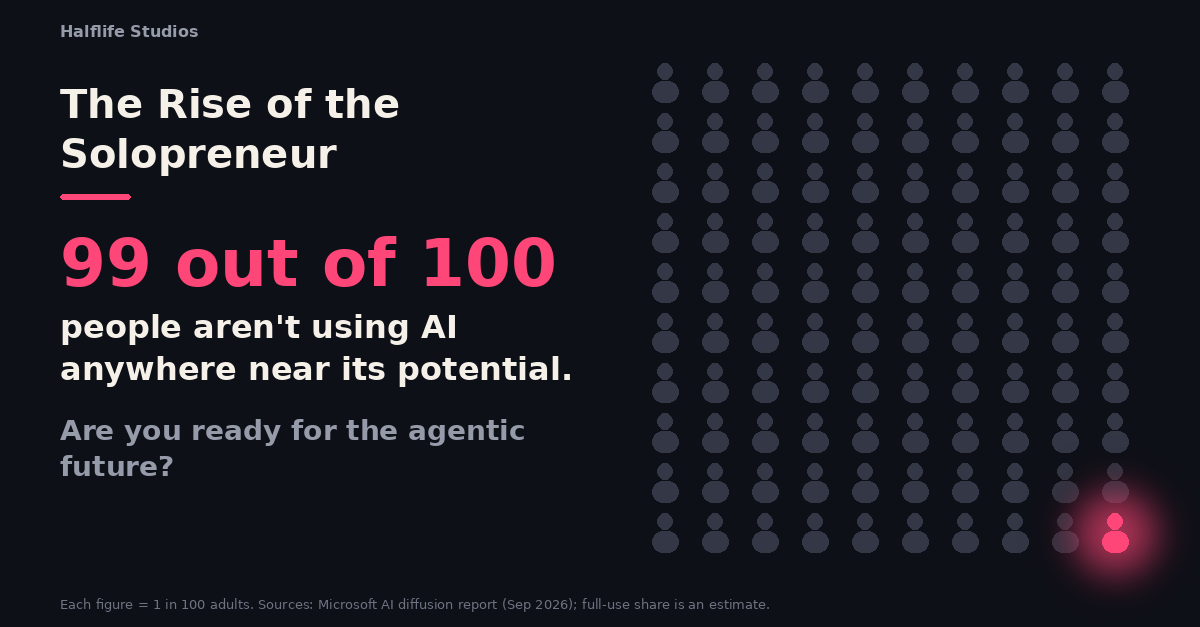
If you feel late, you're not. Zoom out to the whole planet and most people haven't started. The best global measure I've seen found about 4 in 5 working-age adults weren't using AI at all as of mid-2026. My own guess goes further: 99 out of 100 people aren't using AI anywhere near its potential. By my estimate, about 1 percent of people pay for it, and well under 1 percent use it fully, with agents and automation.
Meanwhile, the build-out is something to see. The biggest cloud companies and a wave of newer cloud providers have announced a 75 percent jump in capital spending for 2026, to about $715 billion, according to the International Energy Agency. That's more than the entire US energy sector invested in 2024. The IEA says data centers used 485 TWh of electricity in 2025 and are heading to about 950 TWh by 2030.
Out of curiosity, I did some napkin math, and this is my own scenario. Third-party estimates put paying AI users at roughly 65 million to 110 million people. If every one of them paid $20 a month, that's about $16 billion to $26 billion a year, or about 2 to 4 percent of one year's build. That's subscriptions alone. Data centers pay back over several years, and business and API spending is the bigger path. So the math isn't there yet, which to me means most of the useful stuff is still waiting to be built, by a lot of us.
The IEA also found that a simple text question now uses less electricity than running a TV for the same stretch of time, while agent tasks, reasoning and video can use hundreds or thousands of times more. I do sometimes picture Nvidia Blackwell processors working out whether Sparky the dog likes his kibble. (He does. Sparky likes everything.) For everyday questions like that, a small laptop or the chips already in our phones may be plenty. The heavy machinery makes more sense for heavy agent work, and it will be there when you need it.
Now is a good time to start
To me, this feels like a renaissance. Trying an idea costs so little now that the main limits are imagination and time. There are enough tools out there, and the flavor doesn't matter. Pick one, start small and keep your yes.
As for me, I'll keep building and sharing what works. If it lets me pay my bills doing work I love, I'll be a happy guy. I keep coming back to one line: the most advanced tools in the world are still useless without human vision to direct them.
If you run a small or mid-size organization and want a hand setting up agent desks on gear you control, with your team keeping the final say, that's what our Forward Deployment Engineers do at Halflife Studios. I'm always happy to compare notes.
