
 CLASP
CLASPBy Halflife Studios · Private beta
Take the power
of the token back.
Your machines. Your models. Your rules. A local-first desk to govern AI traffic and help you avoid unnecessary cloud calls.
Start with a suitable local model. Use paid cloud capacity deliberately. Check the quality of the result.
CLASPPolicy & budgetsLocal first.
Cloud only when policy allows.
Your local AI traffic cop
One request.
The right place to work.
Set the rules.
Placement and token budgets come first. Local-first is the default. Strongbox-tagged requests require an allowed local-only route or stop.
Choose the model.
NVIDIA Switchyard’s embedded libsy selects from the models CLASP’s policy permits.
Find a machine.
NVIDIA Personal AI Router directs independent requests to eligible model-serving nodes on your local network.
Switchyard picks the play. PAIR picks the machine. CLASP holds the claw.
CLASP means Cloud–Local Agent Security Proxy. Point a compatible OpenAI or Anthropic client at its local base URL. Workers run compatible model engines such as Ollama or LM Studio with PAIR; CLASP runs at the desk.
One ecosystem · Two choices
CLASP governs the work.
Agora shapes the circle.
CLASP decides which model requests are allowed and where they may run. Agora explores who can participate and what they may share. Membership must never override local-only policy.
Built with NVIDIA tools.
Made for your own lab.
This is an independent Halflife Studios integration of NVIDIA’s open-source tools. It is not an announced NVIDIA partnership or certification.
Two eligible workers can handle separate requests concurrently. PAIR sends each request to one node; it does not merge GPU memory or split a single model across all your computers. The model engine determines hardware acceleration and memory needs.
The tools behind the routing
Clear roles.
Better-directed work.
 SwitchyardModel selection within permitted options
 Personal AI RouterIndependent requests to eligible local nodes
CLASP integrates NVIDIA open-source tools. Agora’s connection to CLASP is in design. CUDA can accelerate inference on supported NVIDIA hardware when the selected model engine uses it; it is not the policy or sharing layer.
Token Sipping
More useful work.
Fewer unnecessary calls.
Try a suitable local model for routine summaries, drafts and coding assistance. Reserve paid cloud capacity for tasks where its added capability is worth the cost. Check answer quality before moving a workflow.
Local still uses tokens.
The opportunity is to avoid an unnecessary paid cloud call. Local electricity, hardware and your time still have costs. Retries count too.
Compare the outcome.
Judge correctness, time to a usable answer and corrections needed. Estimated avoided API spend is not a provider credit or a measured energy saving.
Know what is ready.
See what comes next.
The routing desk
- Local operator UI
- OpenAI and Anthropic API-compatible entry points
- Placement policy and Strongbox local-only handling
- Token allotments and cloud escalation rules
- Embedded Switchyard and local PAIR endpoint integration
A clearer interface
- Chat-first desk and model checks
- Desk hardware snapshot
- Setup and support screens
- Optional usage comparisons
- Session milestones and harness task briefs
Under review. Session counters reset; task briefs are not an executing scheduler.
A growing lab
- Guided onboarding
- Trusted peer inventory and per-worker jobs
- Persistent useful-work scorecards
- Opt-in community challenges
- Photo-assisted setup and native mobile companions
Product tour
Meet the desk.
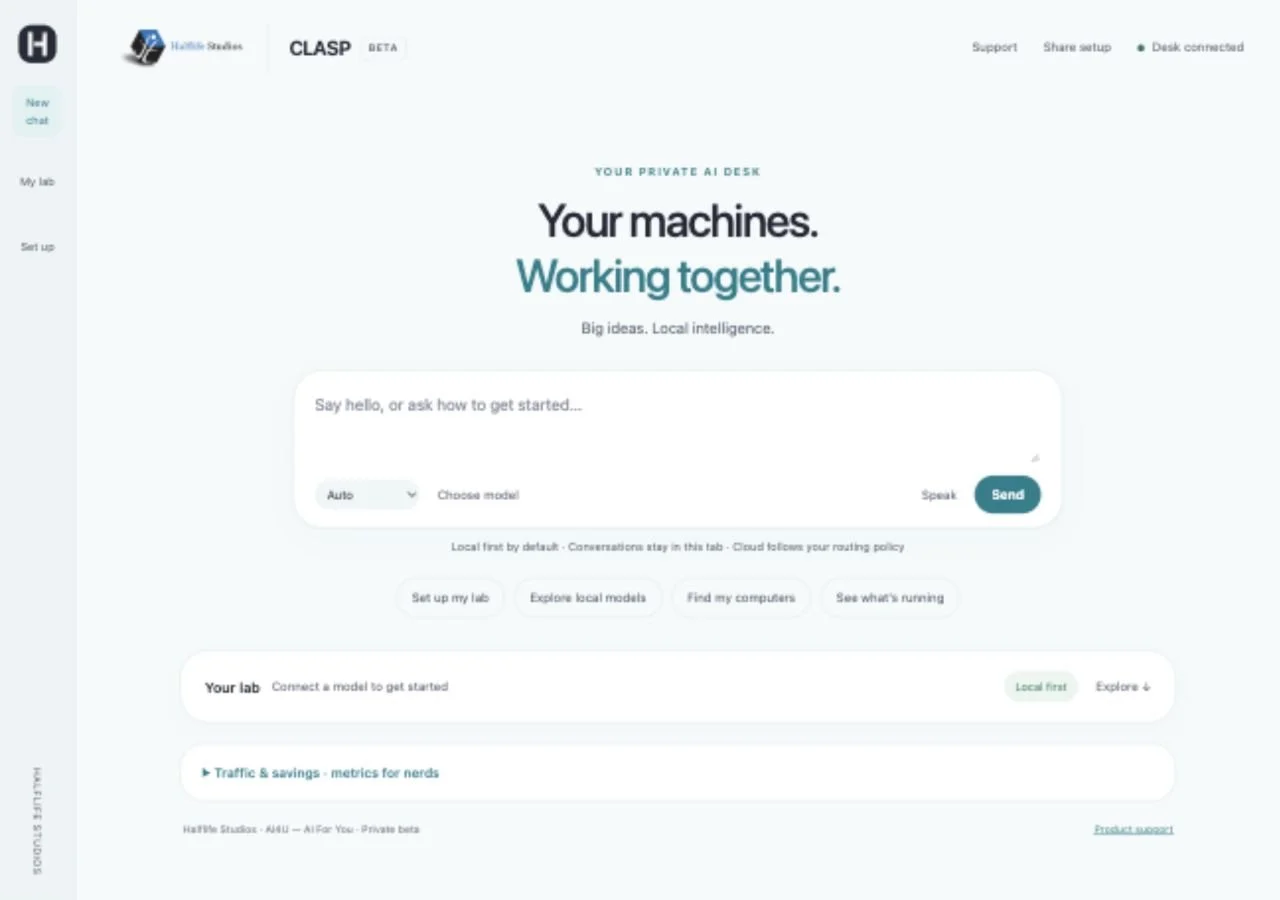
Watch NVIDIA’s PAIR network demo ↗ — an upstream demonstration, separate from CLASP.
Start with one computer.
Choose one useful task. Check your OS, RAM and GPU memory. Run a model that fits, test its answers, then add compatible trusted workers when you need more concurrent capacity. A photo of a case cannot establish its specifications.
Private repository: approved access required. A GitHub 404 can mean you lack access; an example version tag is not a release promise.
Why Halflife started this
Learning AI.
Along with the rest of us.
“I’m Taishi, from Halflife Studios. I’m learning AI alongside everyone else. CLASP starts with a simple question: what useful work could the computers we already own be doing?”
Start small, test a real task and make the next setup a little better. That is the spirit behind CLASP.
Why CLASP · Founder’s story
AI moved fast.
The work needed direction.
For Taishi, working with more models and agents brought a growing coordination burden: which tool should handle a task, where should it run, and did the other agents know what was already happening?
CLASP grew from wanting more control over that traffic and less wasteful token use. Its direction is to apply the user’s rules, use suitable local capacity and make cloud use deliberate. Your machines. Your models. Your rules.
Agora grew alongside that idea to address the conversation: who is working on what, what they are saying and which decisions have actually been agreed. Its goal is to bring supported agents into a shared thread, then carry a clear, attributed handoff back to GitHub.
CLASP: direct the work.
Policy, budgets and permitted model routes, with local-first operation and deliberate cloud participation.
Agora: coordinate the team.
Planned visibility into harnesses, agents, tasks and authorized conversations, with explicit sharing boundaries.
Owner’s motivation and product direction. Shared task visibility and cross-platform conversation integrations remain planned.
Choose how your agents connect · Planned
Your agents.
Your sharing choices.
The direction is to let you choose a communication backend in CLASP. Agora is the intended recommended default for explicit membership and disclosure controls, with WhatsApp, Telegram, Signal and Discord as proposed optional channel integrations.
Know who is working on what.
Planned views would connect harness, agent, task and acknowledged status with authorized conversation threads. Each harness and channel needs a supported, tested adapter; Agora would not read every account or private chat automatically.
Share only what you choose.
The proposed token model grants scoped permission: who may receive which content, for what action, and for how long. These are sharing permissions, not model tokens.
Design direction, not available connectors or a verified security comparison. External channels have their own data handling; a permission token does not encrypt or sanitize a message by itself.
A few clear answers
Start with confidence.
What does CLASP do?
CLASP applies placement and token-budget rules to model requests. Switchyard selects a permitted model; PAIR routes eligible local requests to a machine. Start with one configured model and a small task.
Why would I use Agora as well?
CLASP directs model work. Agora is being designed to coordinate people and AI teammates: who is working on what, which conversations may be shared and what was agreed. Together, the goal is clearer routing and clearer collaboration. CLASP can operate without Agora; the connection is not yet a verified working integration. Discover Agora’s role →
Can I use both products offline?
The product requirement is local offline use after initial verification. CLASP can serve configured local model routes when the needed models and services are available on your computer or LAN. Agora’s offline identity and sharing controls remain planned. Cloud models and external messaging services need a connection.
How does CLASP handle private requests?
Strongbox-tagged requests require an allowed local-only route or stop. This is a routing rule, not an encrypted vault or a guarantee that every worker is safe. Use trusted machines and review what your harness sends.
Will local models save me money?
A suitable local model can avoid some paid cloud calls. Compare answer quality, hardware costs and electricity as well as API charges. Estimated avoided spend is not a provider credit or measured energy saving.
Where do I start?
Read the installation guide and the private beta’s current download instructions. Access and compatible release availability must be checked; the website registration flow is only a preview.
Better understood together
Bring your team into the picture.
CLASP governs model traffic. Agora’s planned shared threads and permission choices would help your people and agents agree on the work. Start with CLASP; explore Agora as your collaboration grows.
Local-first direction, not a blanket security promise. Agora and the combined offline experience remain in development; online services still require connectivity.